
You fall asleep, and a few hours later the alarm goes off.
It feels like one long blank stretch in between.
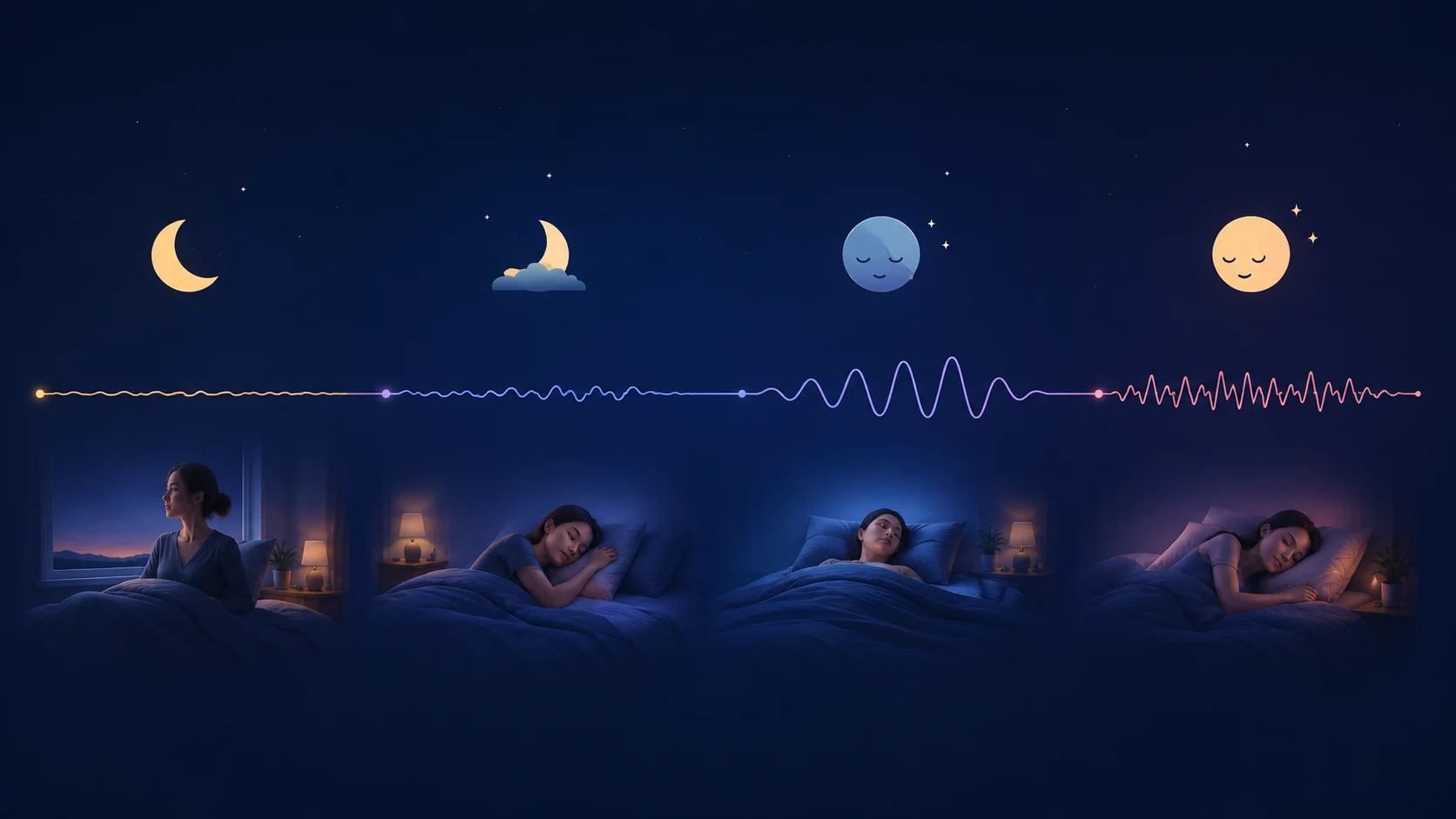
But sleep is not one continuous state. Your brain does not simply press an “off” button and stay there until morning. Instead, it moves through a repeating sequence of lighter sleep, deeper sleep, and REM sleep.
A typical sleep cycle lasts roughly 80 to 100 minutes, and most people go through several cycles in one night. The pattern changes as the night continues: deep sleep is more common earlier, while REM periods usually become longer closer to morning. 1
That explains why being woken at 2 a.m. can feel completely different from waking five minutes before your alarm.
Light Sleep: You Are Asleep, but Not Very Far Away
Light sleep is the bridge between being awake and being more deeply asleep.
During the first stage, your muscles begin to relax and your awareness of the room starts to fade. You may still feel as though you are awake. A small noise, a door closing, or someone whispering your name may bring you back quickly.
This is also the stage where your body occasionally decides to create drama.
You may feel as though you are falling, followed by a sudden leg or arm jerk. One second you are drifting off peacefully; the next, your whole body has reacted as though you missed a step on an invisible staircase.
The next part of light sleep is more stable. Your heart rate slows, your breathing becomes more regular, and your body temperature begins to drop. You are harder to wake than before, but not yet in the deepest part of sleep.
Calling it “light sleep” can make it sound unimportant. It is not. Light sleep takes up a large part of the night and helps carry you into the deeper stages that follow. 1
Deep Sleep: The “What Year Is It?” Stage
Deep sleep is the stage most people imagine when they think of being completely asleep.
Brain waves become slower and more synchronized. Heart rate and breathing slow, muscles relax, and waking up becomes much more difficult. Deep sleep is concentrated more heavily in the earlier part of the night. 1
If someone wakes you during deep sleep, you may sit up looking confused, annoyed, and briefly unsure where you are.
That heavy feeling is called sleep inertia.
Deep sleep is associated with physical restoration. It supports tissue repair, immune function, growth, and the processes that help you feel physically refreshed the next day. 2
This does not mean you need to spend the night worrying about whether you are getting enough deep sleep.
In fact, worrying about sleep stages at 1:30 a.m. is a remarkably effective way to stay awake.
A regular schedule, enough time in bed, and a comfortable sleep environment are more useful than repeatedly checking a sleep-tracking app and judging yourself by a graph.

REM Sleep: The Brain Gets Busy Again
REM stands for rapid eye movement.
During REM sleep, the brain becomes highly active. The eyes move quickly behind closed eyelids, breathing becomes less regular, and most large muscles are temporarily prevented from moving normally. REM first appears roughly 90 minutes after falling asleep, although the exact timing varies. 3
That temporary reduction in muscle movement is helpful.
Without it, a dream about running away from a bear, missing a flight, or giving a presentation in your pajamas could become a much more physical experience for whoever is sleeping beside you.
Vivid dreams are common during REM sleep, although dreaming can also happen in other stages. REM is associated with memory, learning, and emotional processing. 3
Early REM periods tend to be short. Later in the night, they become longer.
That may be why the most detailed, bizarre, and emotionally complicated dreams often appear shortly before morning—right before the alarm interrupts the plot.
You Do Not Move Through the Stages Only Once
Sleep stages repeat.
You normally move from lighter sleep into deeper non-REM sleep, return toward lighter sleep, enter REM, and then begin another cycle. This happens several times throughout the night. 1
The cycles are not identical.
The first part of the night usually contains more deep sleep. The second half contains more REM sleep. That means cutting the night short may affect the later REM-rich portion, while going to bed very late can also reduce the opportunity for a normal pattern of sleep.
You may briefly wake between cycles without remembering it.
You turn over, pull the blanket back up, notice the rain outside, and fall asleep again. By morning, the moment has disappeared.
Brief awakenings are a normal part of sleep. They become more concerning when they are frequent, prolonged, or leave you consistently exhausted during the day.
Which Sleep Stage Is the Most Important?
This question is a little like asking which part of dinner matters most.
The vegetables? The protein? Dessert?
Deep sleep often gets the most attention because it is linked with physical restoration. REM sounds more exciting because it involves vivid dreams and active brain processes. Light sleep sounds less impressive because of the word “light.”
But healthy sleep depends on moving through the whole pattern.
You need the transitions. You need the deeper stages. You need REM.
One stage does not work as a substitute for all the others.
The goal is not to maximize one stage like a score in a game. It is to give your brain and body enough uninterrupted time to move naturally through repeated cycles.
Can Music or Sounds Change Your Sleep Stages?
Music and background sounds cannot guarantee more deep sleep or REM sleep.
However, a calm and consistent environment may make it easier to settle and may reduce disruption from unpredictable noise.
Quiet Sleep Music, Sleep Sounds, White Noise, or gentle Rain Sounds can help make the room feel steadier if outside sounds keep catching your attention.
Keep the volume low. The goal is not to actively listen all night. The sound should fade into the room.
Why Sleep Trackers Are Not Always the Final Answer
Wearable devices can estimate sleep stages using movement, heart rate, and other signals.
They can be interesting, but they are not the same as a clinical sleep study, which uses sensors to measure brain activity, eye movement, breathing, and other signals. Sleep stages are formally classified using this more detailed information. 1
So if your watch tells you that you received exactly 47 minutes of deep sleep, try not to let that number ruin your morning.
Pay attention to the larger picture.
Do you feel rested? Are you sleepy throughout the day? Is your sleep regularly interrupted? Those patterns may matter more than one night’s score.
Final Thoughts
Sleep is not a flat line.
It is a repeating journey through lighter sleep, deep sleep, REM, and brief transitions in between.
Light sleep helps you move away from wakefulness. Deep sleep supports physical restoration. REM brings an active brain, vivid dreams, and processes connected with memory and emotion.
Then the cycle starts again.
All night, your brain and body keep changing gears—without asking you to manage any of it.
Honestly, it is probably best that way.
References
- National Heart, Lung, and Blood Institute — Sleep Phases and Stages
- National Heart, Lung, and Blood Institute — Your Guide to Healthy Sleep
- National Institute of Neurological Disorders and Stroke — Brain Basics: Understanding Sleep