
You turn off the light, pull up the blanket, and—assuming the night goes reasonably well—disappear for several hours.
At least, that’s what it feels like.
From the outside, sleep looks like a whole lot of nothing. But inside your brain and body, the night is anything but empty.
Your brain moves through different sleep stages. Your breathing and heart rate change. Muscles relax, memories are processed, and the systems that keep you functioning during the day continue their night shift.
Sleep isn’t simply the absence of being awake. It is an active, carefully organized process.
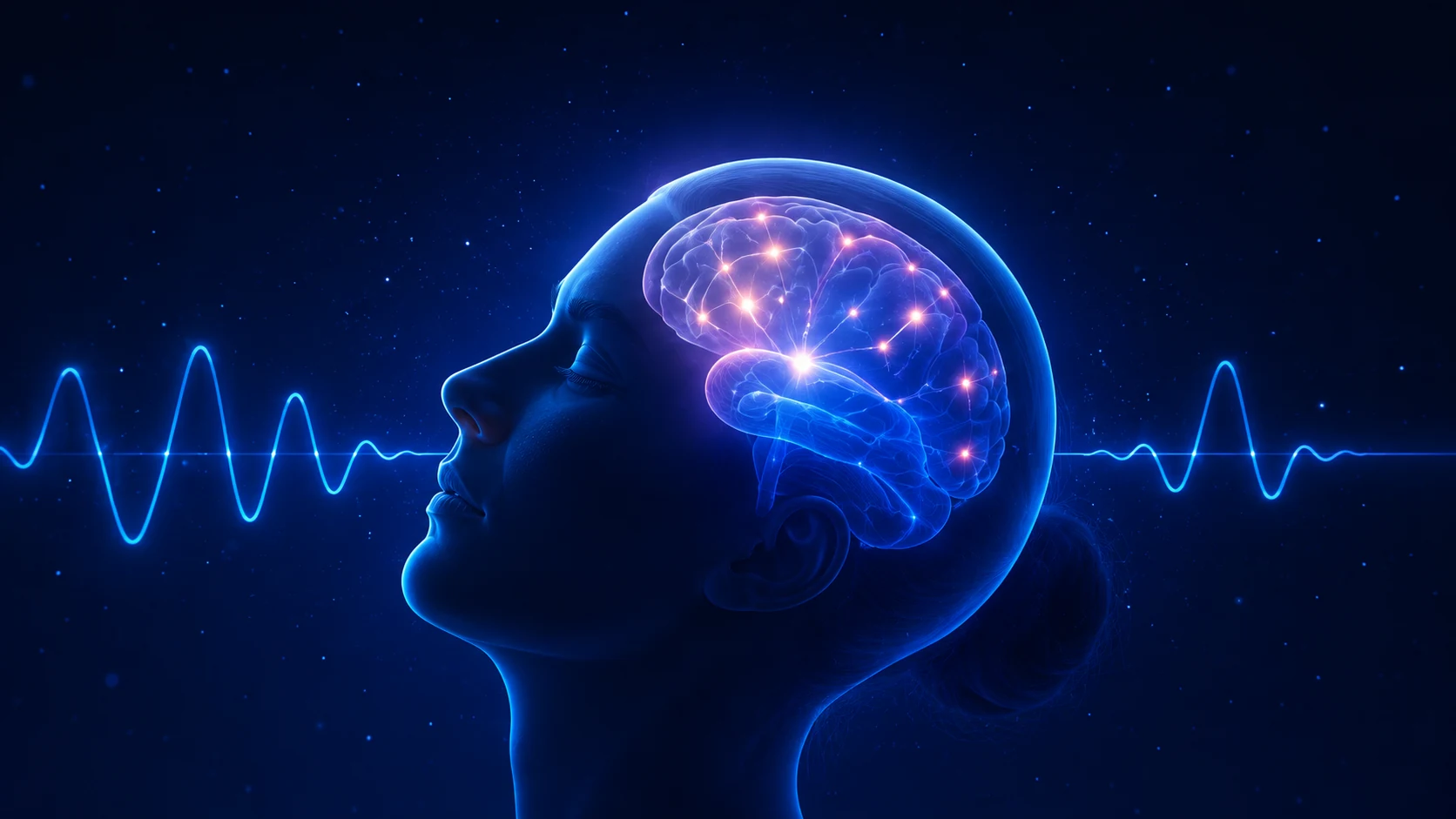
Your Internal Clock Starts Preparing You for Sleep
Long before you get into bed, your body is already keeping track of time.
An internal system known as the circadian rhythm helps regulate when you feel awake and when sleep becomes more likely. Light is one of its strongest signals. As evening gets darker, melatonin levels usually begin to rise, helping your body prepare for sleep. Morning light supports the shift back toward wakefulness. 1
Of course, the system doesn’t always get a quiet working environment.
Late-night screens, irregular schedules, shift work, travel, and the decision to watch “just one more episode” can all affect when sleepy feelings arrive.
This is one reason a regular evening routine can help. Lower lighting, fewer stimulating activities, and quiet Sleep Music or Sleep Sounds can make the transition into bedtime feel more obvious.
Falling Asleep Is Only the Beginning
Once you fall asleep, you do not remain in one unchanging state until morning.
Instead, you move repeatedly through two broad types of sleep: non-REM sleep and REM sleep. A complete cycle usually lasts roughly 80 to 100 minutes, and most people move through several cycles during the night. 2
The balance also changes as the night continues. Deep sleep tends to be more concentrated earlier, while REM periods generally become longer toward morning.
So the sleep you get at 1 a.m. is not identical to the sleep you get shortly before the alarm rings.

Light Sleep: The Changeover From Wakefulness
The first stage is the doorway between being awake and being asleep.
Your muscles begin to relax, your eye movements slow, and your awareness of the room starts to fade. You may still feel as though you are awake, especially if someone disturbs you.
This is also when you might experience the sudden sensation of falling, followed by a quick muscle jerk that makes you wonder why your body has chosen bedtime to become dramatic.
The next stage is more stable light sleep. Heart rate and breathing slow, body temperature drops, and brain activity changes. Although this is called “light” sleep, it is not unimportant. In fact, it makes up a substantial part of a typical night.
Deep Sleep: The Hard-to-Wake Stage
As sleep deepens, brain activity becomes slower and more synchronized. Your heart rate and breathing reach lower, steadier levels, and your muscles become deeply relaxed.
This is the stage people often imagine when they talk about being “completely out.”
Wake someone during deep sleep and they may sit up looking as though they have briefly forgotten what year it is. That heavy, confused feeling is called sleep inertia.
Deep sleep is associated with physical restoration and supports processes involved in growth, repair, immune function, and waking refreshment. 3 It tends to occur more during the first part of the night, which is one reason repeatedly delaying sleep can affect more than total hours alone.
You cannot force deep sleep by trying harder. A comfortable room and a consistent schedule are more useful than worrying about whether your sleep tracker awarded you enough points.
REM Sleep: An Active Brain in a Resting Body
REM stands for rapid eye movement.
During REM sleep, brain activity becomes more similar to waking activity. The eyes move rapidly beneath the eyelids, breathing becomes less regular, and most large muscles are temporarily kept from moving normally.
That last part is useful. Without it, acting out a dream about running through an airport could become inconvenient for whoever shares your bed.
Vivid dreaming is common during REM sleep, although dreams can occur in other stages too. REM sleep is linked with learning, memory, and emotional processing. 3
The first REM period is usually relatively short. Later in the night, REM episodes become longer, which may explain why elaborate dreams often appear close to morning—and why an alarm can interrupt them at the most interesting moment.
Your Body Does Not Simply “Shut Down”
While you sleep, different systems change their pace rather than switching off.
Heart rate and blood pressure generally fall during non-REM sleep. Breathing becomes slower and more regular, although it varies during REM. Hormones continue following overnight patterns, and the body carries out maintenance that supports normal daytime function. 3
Your brain is busy too. Sleep contributes to learning and memory, attention, mood, and overall health. Good sleep quality matters alongside total sleep time. 4
This does not mean that every night must be flawless. Human sleep naturally includes movement, changes in depth, and brief awakenings.
Why Do You Wake Up During the Night?
Waking briefly does not automatically mean you slept badly.
You may surface between sleep cycles, turn over, adjust the blanket, or notice a noise before falling asleep again. Often, you will not remember it the next morning.
Problems are more likely when awakenings are frequent, prolonged, or leave you consistently exhausted during the day. Noise, temperature, stress, pain, alcohol, caffeine, medications, and sleep disorders can all affect sleep continuity.
A steady background such as White Noise, gentle Rain Sounds, or Nature Sounds may help when unpredictable environmental noise keeps interrupting the room.
Sleep Is a Cycle, Not a Flat Line
A good night’s sleep is not eight hours of identical unconsciousness.
It is a repeating pattern: lighter sleep, deeper sleep, REM, brief transitions, and then another cycle. Some nights the pattern runs smoothly. Other nights it is disrupted by stress, noise, illness, a warm room, or the deeply questionable decision to drink coffee late in the afternoon.
That variation is normal.
The useful goal is not “perfect sleep.” It is giving your body a reasonable opportunity to move through enough complete cycles: enough time, a fairly consistent schedule, and an environment that does not keep asking for your attention.
Final Thoughts
While you sleep, your body is not doing nothing.
It is changing gears.
Your internal clock guides the timing. Your brain moves through light sleep, deep sleep, and REM. Heart rate, breathing, muscle activity, memory processing, and physical restoration all follow their own overnight patterns.
You do not have to supervise any of it.
In fact, that is rather the point.
References
- National Heart, Lung, and Blood Institute — Your Sleep/Wake Cycle
- National Heart, Lung, and Blood Institute — Sleep Phases and Stages
- National Institute of Neurological Disorders and Stroke — Brain Basics: Understanding Sleep
- Centers for Disease Control and Prevention — About Sleep